Artificial Intelligence Revenues Would Need to Grow by 80 Percent Annually
Benedikt Langer
4 min. reading time Stijn Van Nieuwerburgh of Columbia Business School calculates that AI investment ...
 Read Article

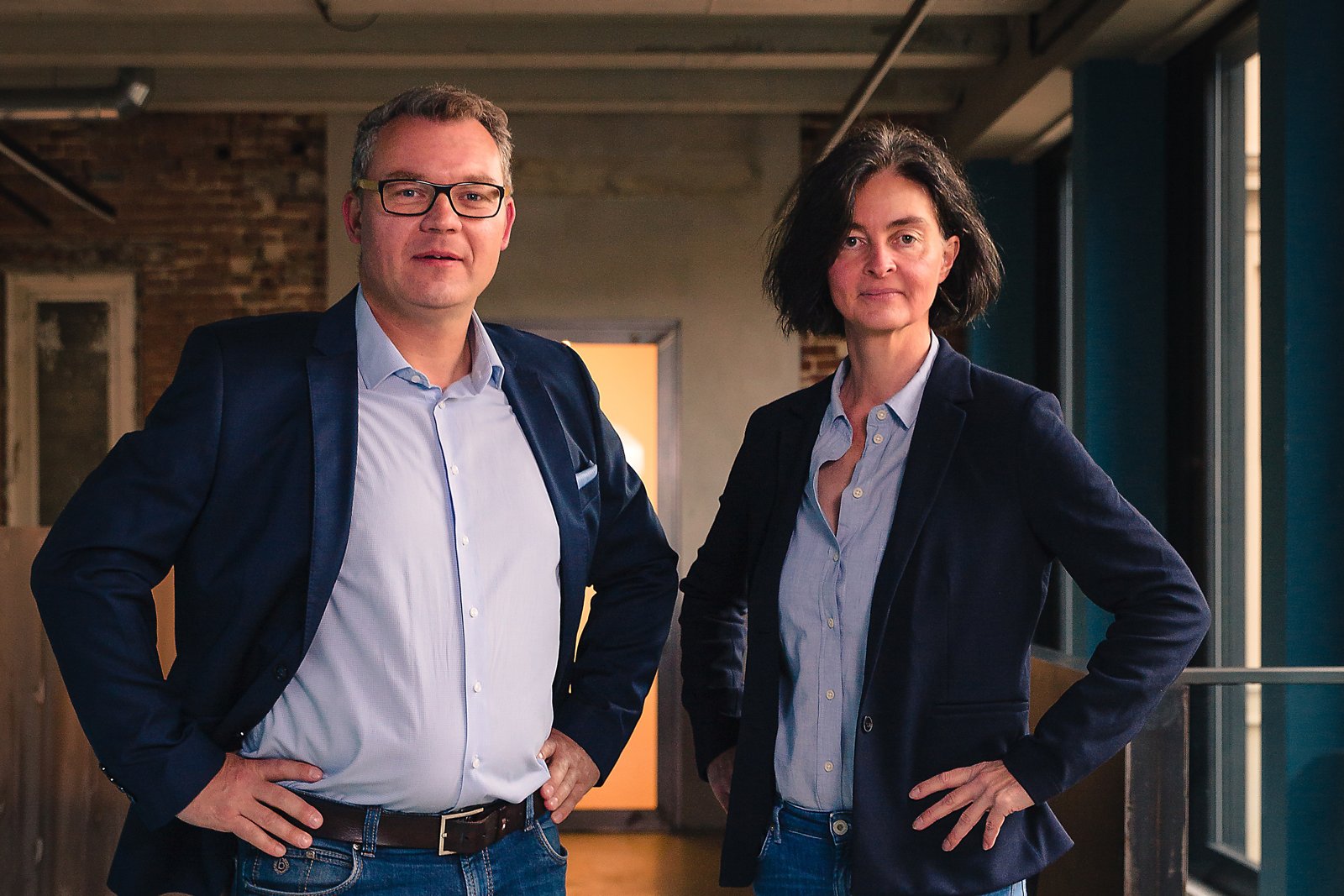
Kerstin Hochmüller and Andreas Schiemann run door-drive manufacturer Marantec from East Westphalia as co-CEOs. They’ve let start-ups loose on their own business model, work with suppliers and competitors alike, and call their company an Open Champion. For CIOs, it’s the stress test that stands out.
Key Takeaways
RelatedCorporate-startup deals without an IT exit / Why start-ups lose customers despite billions in funding
Many Mittelstand firms wear the Hidden Champion title with pride – it stands for the secret world market leader. Andreas Schiemann wants to shed it. “Because we work differently and because we have a different strategy,” says the co-CEO of the Marantec Group in a September interview with Markt und Mittelstand. “We also want to work with start-ups and be less ‘hidden’ and as ‘open’ as possible.”
The line sounds like marketing. Behind it lies a transformation that, according to Marantec itself, began even before the pandemic. “We concluded before Covid that we needed to overhaul our strategy far more radically,” says Kerstin Hochmüller.
The result is a Mittelstand company that voluntarily lets others attack its own business models. It seeks out collaboration with suppliers and competitors. Externally, it talks openly about values rather than product specs. The two call this the Open Champion.
What is an Open Champion? The Marantec Group uses the term Open Champion to describe its self-image as an open company. That includes partnerships with start-ups, suppliers, and competitors, as well as a willingness to let outsiders scrutinize its own business models. The term is deliberately chosen as the counterpart to the Hidden Champion, the secretive world market leader from the Mittelstand.
Marantec is based in Marienfeld, a district of Harsewinkel in the Gütersloh district. The company sees itself as part of Ostwestfalen-Lippe. The company history begins in 1957 with development and production at the headquarters. 1989 marked the starting point for the corporate group, and since 2018 it has operated jointly as the Marantec Group.
| Metric | Value | Source |
|---|---|---|
| History | since 1957 at headquarters, group since 1989, Marantec Group since 2018 | Company data |
| Employees | more than 550 worldwide | Marantec press page |
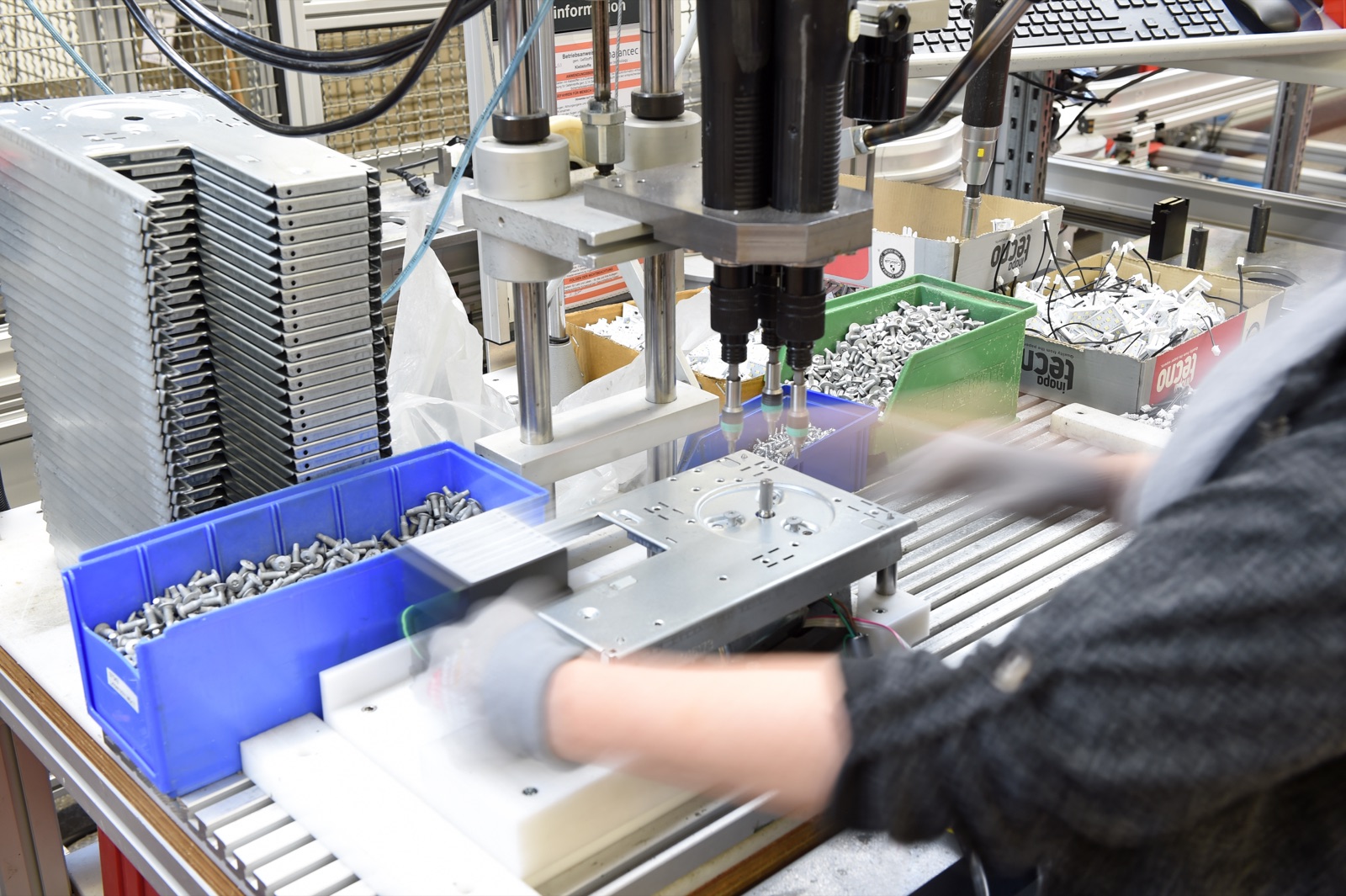
| Products per year | 2.25 million from eight plants | Marantec press page |
| Revenue | around 100 million euros | Marantec press page |
| Equity ratio | 80 percent | Marantec press page |
| Export share | more than 70 percent | Company data |
The company builds drives for doors and gates. Added to that are security systems, software, and digital business models. Sales happen mainly in Europe, through seven sales locations.
At the top sits an Executive Board of four people. Alongside Hochmüller and Schiemann, it includes Michael Schwetje and Eva Stankewitz. Marantec has replaced classic hierarchies with a role-based model. “We think in roles, not positions,” states the group’s website.
The most unusual step was a stress test from outside. “We had our business models stressed by start-ups,” says Hochmüller. According to his description, the young companies pick out the most promising processes and “disrupt them very quickly.” Marantec wanted exactly this outside perspective.
As early as September 2025, Hochmüller had described the approach at the IHK am Puls format in Marburg. “Letting outsiders stress you is a great approach. That’s how we discover what we’re really better at – and where we need to radically readjust.” Marantec does not name which start-ups carried out the test.
The stress test produced a mixed result. In some areas the company considered core competencies, there was no core competency left at all. Elsewhere, strengths emerged that no one in-house had recognized as such. These include knowledge of legal situations and documentation obligations in many countries. “There are so many things that suddenly become a competence we had previously dismissed,” says Hochmüller.
Hochmüller states the goal clearly on the company’s website: “We are making the leap from an industrial company to a digital company. To do this, we are developing new business models and building ourselves a new ecosystem in which we can realize our ideas.”
Collaboration with young companies has a longer history within the company. In 2017, Marantec took a stake in the Vienna-based IoT specialist nymea. In 2019 came a partnership with the Munich start-up Parkhere. With Valuedesk from Bielefeld, the company is working on a cost dashboard.
For IT managers, this is a familiar exercise, just scaled up. A red-team test checks a network’s defenses. Marantec has applied the same principle to its own business model.
Schiemann sees no danger in this openness. “You should free yourself from the belief that you need to guard a great many things that can somehow be copied anyway,” he says. “Unfortunately, there are only very few things left that make a truly decisive difference for technological reasons. The differences lie on other levels.”
He locates the real competition globally. The roughly 200 Mittelstand companies that build geared motors in Germany don’t count among them, in his view. His assessment of the industry is sober: “We all do the same things, we invest in the same things, but we don’t differentiate ourselves. What really matters is: where is our real competition?”
The partnership with the Swiss sensor specialist CEDES shows what this looks like in practice. In February 2024, the two companies presented an IoT partnership for doors and barriers at the R+T trade fair in Stuttgart. The first step was a prototype combining CEDES’s sensor technology and data analytics with Marantec’s drive, control, and IoT expertise. “Here, two pioneers and leading companies are meeting as equals,” Schiemann said at the time. “As an Open Champion, we are always open to exactly this kind of cooperation.” CEDES operates in more than 60 countries and had previously acquired door-sensor specialist Vitector to build up expertise in industrial doors.
A second example comes from Italy. Using drives from manufacturer Key Automation, engineers from both companies put together a program for outdoor gates and parking barriers that expands Marantec’s own portfolio. The goal is complete solutions for protecting property boundaries. Key Automation CEO Nicola Michelin cites Marantec’s international sales network as the main reason for the partnership.
These two partnerships are not isolated cases. The group’s factsheet lists GfA and Valuedesk as partners alongside CEDES and Key Automation. Marantec does not disclose how much revenue flows through these collaborations.
Hochmüller has a simple guiding question for this approach. “What do we actually need? Who out there in the world already knows how to do it?” she said in September 2025 on the n-tv podcast “So techt Deutschland”. Sharing is the new having, she says, through partnerships with start-ups, suppliers, and competitors.
As an example, she cited an Italian supplier of external gate drives, without naming it. What began as a customer-supplier relationship grew into joint development. The effects, according to Hochmüller: new markets, shared investment, and more speed.
This mindset extends all the way into communication. Products are becoming ever more comparable, Hochmüller says. At the same time, sales channels have changed drastically. What tips the scales now are personal experience and emotion. Since then, Marantec has put its own organization front and center in its communications, including its role-based model without classic hierarchies.
The effect caught the leadership team itself off guard. Outside attention was “suddenly far greater” than expected. The Open Champion philosophy migrated from the outside in. “We slid into it, and now there’s no going back,” says Hochmüller.
The path wasn’t an easy one. Schiemann sees getting employees on board as a major challenge, especially the engineers. They had spent decades refining these products. The idea that they should now share them with start-ups or competitors was, at first, met with disbelief.
In the end, according to Schiemann, it was the results from individual projects that won people over. “It takes a certain amount of time, guidance, and constant motivation, along with a continued focus on what truly sets us apart,” says Schiemann.
The friction tends to surface more in day-to-day operations than at the shareholder level. In sales, for instance, there was debate over how a joint project could possibly work with the company’s “biggest enemies to date.” In Schiemann’s experience, good cooperation has to run through multiple levels, from product management through marketing to strategy. And it has to “develop over a very long time.”
Openness also shapes how Marantec approaches new technology. In a column published in June 2025, Hochmüller described two in-house AI applications. An AI-powered FAQ center supports customer service, provides only vetted answers, and learns from the expertise of specialists. A second tool turns descriptions of workflows into process diagrams in the BPMN standard within seconds. Marantec uses its own solutions for this, alongside tools such as Google Gemini and Rodlane’s “Maia”.
The rules governing this are brief: “The AI has to fit into everyday work. Employees need to feel the benefit directly. And the quality of the results has to be right.”
When it comes to materials, Marantec thinks in cycles. In the K-Zeitung, Hochmüller called the circular economy a “brutal economic necessity” against dumping prices and dependence on China. She called for simpler rules for take-back systems and standardized CO2 calculations for recycled material. Marantec uses plastics that are fully recyclable, she wrote. But recyclates are often more expensive than new plastic. On top of that, existing standards prevent their use.
The most visible result is the Flora garage door operator. It was designed from the outset to allow the installation of tested used parts – remanufacturing, in industry jargon. According to WDR, the model produces roughly a quarter less CO2 in production. “We managed to cut the number of components in half,” Schiemann told the broadcaster. Customers contractually commit to returning the operator after around ten years. Hochmüller sees this as an argument for the location as well. “Once the price argument is gone, customers support us in producing in Germany and becoming ever more sustainable.” For the workforce, the product is “extremely motivating,” she told WDR, especially since many employees feel the pressure of competition from Asia.
Hochmüller knows the mood in the Mittelstand well. “It’s rarely talked about how many entrepreneurs have simply lost the will to carry on,” she said on the n-tv podcast. Some companies simply give up because they lack the energy. Marantec has chosen the opposite path and is looking for allies.
Schiemann starts with giving. “Giving something without immediately expecting something in return – that’s a basic requirement for a successful partnership,” he says. “German Mittelstand companies need to learn that.”
For CIOs and managing directors, the pair’s path yields three questions worth examining. The first concerns supposed core competencies that wouldn’t survive an outside attack. The second looks for underrated strengths, for instance in knowledge of regulations and markets. The third asks about the competitor with whom more could be achieved together than alone.
Whether this openness pays off will show in the results: in the partnerships with CEDES and Key Automation, and in the Flora drive, whose take-back model still has to prove itself over roughly a decade.
Co-CEO Andreas Schiemann explains that Marantec works differently and pursues a different strategy. The company wants to collaborate with start-ups and present itself as openly as possible.
Start-ups revealed that Marantec no longer had strength in some supposed core competencies. At the same time, underestimated competencies came to light, such as knowledge of legal frameworks and documentation requirements in many countries.
Flora is a garage door drive that Marantec designed from the outset with the installation of tested used parts in mind. According to WDR, it has about half as many components and causes roughly a quarter less CO2 in production; customers return it after about ten years.
Read more on Digital Chiefs
Digital ChiefsNvidia Buys Hugging Face for Over 11 Billion EurosDigital ChiefsSAP Lets Joule Steer Robots Directly, Liability Still OpenDigital ChiefsChatGPT wants to read the MacMore from the MBF Media Network
mybusinessfutureDigital Product Passport: What Manufacturers Need to Do cloudmagazinThe AI Pilot That Puts Operations First securitytodayShadow AI Often Emerges From Governance ItselfImage source: AI-generated (September 2026)
4 min. reading time Stijn Van Nieuwerburgh of Columbia Business School calculates that AI investment ...
Read Article
7 min read Since late June 2025, the Accessibility Strengthening Act (BFSG) has applied to many digital ...
Read Article
This article is an AI-generated translation of the German original. The German version is authoritative. 4 ...
Read Article
This article is an AI-generated translation of the German original. The German version is authoritative. 4 ...
Read Article
This article is an AI-generated translation of the German original. The German version is authoritative. 5 ...
Read Article